
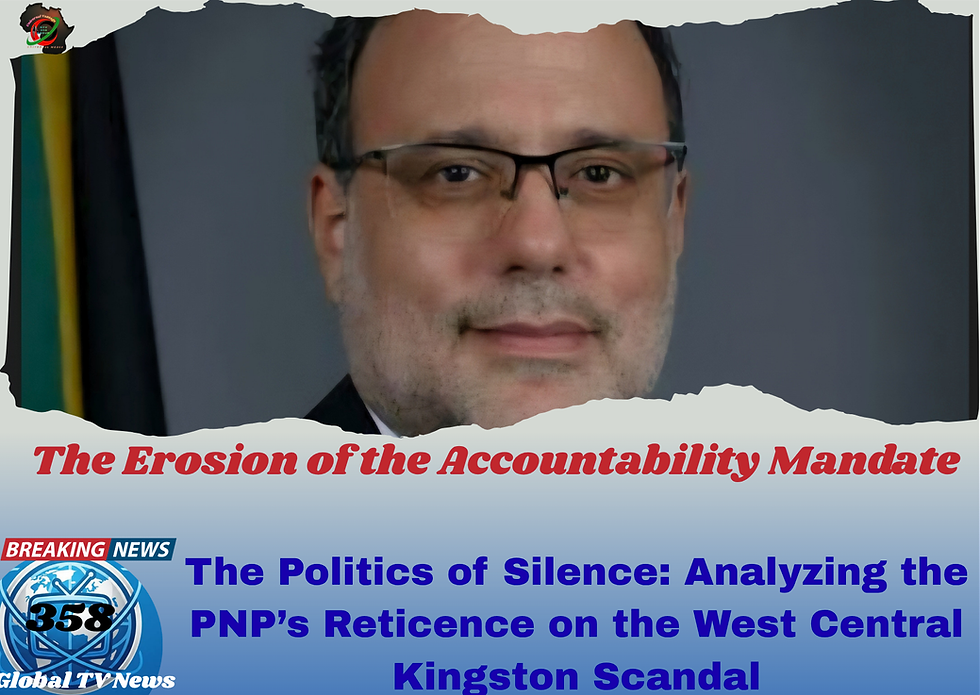
The Politics of Silence: Analyzing the PNP’s Reticence on the West Central Kingston Scandal


By: Wayne Forbes /GTV Editor
March 26th 2026
The Politics of Silence: Analyzing the PNP’s Reticence on the West Central Kingston Scandal
In the volatile arena of Jamaican politics, silence is rarely an accident; it is a strategy. The recent allegations surrounding the West Central Kingston taxpayer money scandal have sparked significant public outcry, yet the People’s National Party (PNP) has remained notably reserved. This reticence in the face of alleged financial impropriety raises critical questions about political accountability, internal party dynamics, and the strategic calculus of the opposition in a hyper-partisan environment.
The Strategic Calculus of "Oxygen"
From a communications perspective, the PNP’s silence can be interpreted as a defensive maneuver to control the news cycle. In political science, the "oxygen" theory suggests that any response to a scandal—even a forceful denial—serves to keep the story in the headlines. By refusing to engage deeply with the West Central Kingston allegations, the PNP may be attempting to starve the controversy of the attention it needs to grow.
In a landscape where the Jamaica Labour Party (JLP) is quick to capitalize on opposition missteps, a detailed defense from the PNP could provide the ruling party with specific talking points to pivot away from their own administrative challenges. The PNP likely views the risk of a "backfire effect"—where their explanations are scrutinized and used against them—as greater than the cost of appearing indifferent.
Internal Patronage and Local Power Structures
Beyond national optics, the silence points toward the complex and often opaque nature of constituency management. West Central Kingston is a region where political loyalty is often intertwined with social intervention and local influence. If the allegations involve the distribution of funds through traditional "grassroots" channels, the party leadership faces a paradox: to condemn the actions is to potentially dismantle the very machinery that secures their local base.
Investigating or speaking out against influential figures within a constituency risks alienating local power brokers who command significant voter blocks. For the PNP, maintaining internal cohesion and ensuring the loyalty of its local organizers often takes precedence over the optics of fiscal transparency. This suggests that the party’s silence is not just a shield against the public, but a peace offering to its own internal factions to prevent a fragmentation of the party's local power.
The Erosion of the Accountability Mandate
Perhaps the most significant implication of this silence is its impact on the Jamaican electorate’s trust. As the official opposition, the PNP’s primary constitutional role is to act as a watchdog for the public interest. When a party remains silent on issues involving the potential misuse of taxpayer funds, it risks validating the "straight-pour" narrative—the cynical public belief that both major parties protect one another to preserve a status quo of impunity.
By failing to lead with a transparent and critical self-examination, the PNP misses an opportunity to distinguish itself as a party of superior ethical standards. While staying quiet might protect the party from immediate political fire, it reinforces a culture of omertà that hampers national development. In the long run, this strategy may prove costly, as younger and more disillusioned voters demand a brand of politics that prioritizes the sanctity of the public purse over the survival of the party's image.
Conclusion
The PNP’s quietude regarding the West Central Kingston scandal is a multifaceted phenomenon. It is a blend of tactical media management, a survivalist approach to internal party loyalty, and a symptom of a political system that often prioritizes power over transparency. However, as Jamaica moves toward a more digitally connected and demanding civil society, the "politics of silence" may no longer be a viable shield for either side of the political divide.
Do you think the PNP's silence will significantly affect their performance in the upcoming elections, or will voters prioritize other national issues?

Comments