
The Sound of Silence: Analyzing the PNP’s Passivity Amidst the West Central Kingston Taxpayer Debacle


By: Wayne Forbes /GTV Editor
March 25th 2026
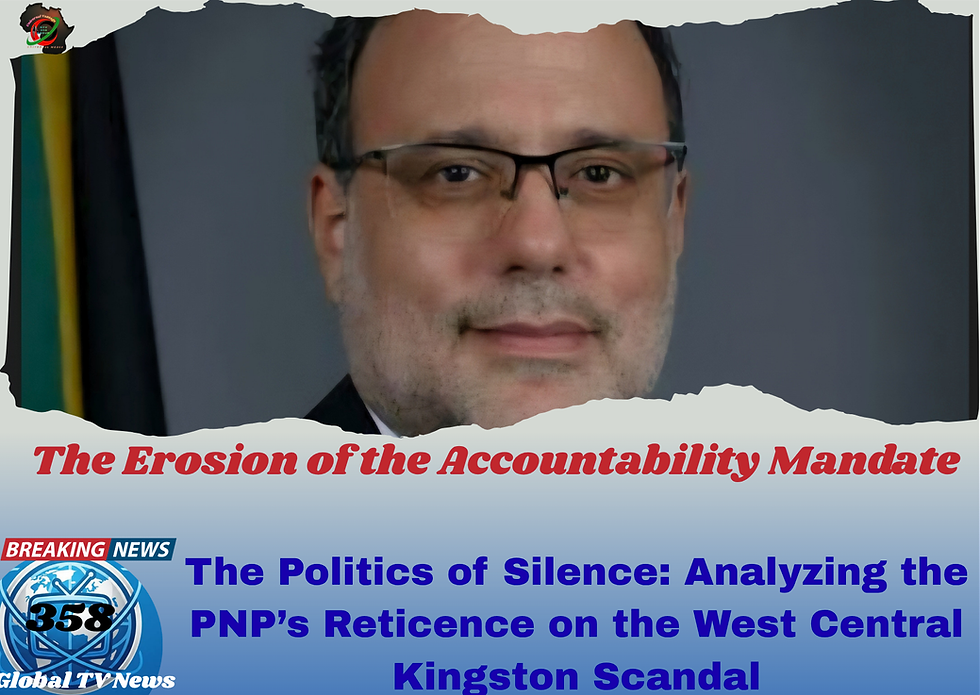
The Sound of Silence: Analyzing the PNP’s Passivity Amidst the West Central Kingston Taxpayer Debacle
In the volatile arena of Jamaican politics, silence is rarely just the absence of noise; it is a calculated—or perhaps miscalculated—political statement. Currently, the political landscape is being rocked by a public and messy "debacle" in West Central Kingston involving high-ranking Jamaica Labour Party (JLP) figures. When a Member of Parliament and a Councillor from the same governing party engage in a public spat over the allocation and management of taxpayer funds, it typically signals a moment of extreme vulnerability. However, the most curious element of this saga is not the infighting itself, but the relative quietude of the People’s National Party (PNP). The headline, "The JLP Internal War over Public Funds: Why is the Opposition Staying Quiet?", serves as a jarring indictment of the current state of opposition politics in Jamaica.
The Anatomy of an Internal War
The conflict in West Central Kingston is more than a simple personality clash; it is a fundamental breakdown in the administration of public resources. When taxpayer money becomes the bone of contention between an MP and a Councillor, it suggests a lack of oversight, transparency, and institutional control within the governing party’s constituency machinery. For the JLP, this "internal war" is a public relations nightmare that exposes cracks in the party's "Prosperity" narrative. It reveals a scenario where personal or factional interests may be superseding the collective duty to serve the constituents of Kingston.
In a healthy democracy, such an opening is a "golden ticket" for the opposition. Usually, a political party out of power would seize this opportunity to frame the government as disorganized, self-serving, and fiscally irresponsible. By highlighting the internal friction, the PNP could effectively argue that if the JLP cannot manage its own internal distribution of funds without public warfare, they cannot be trusted with the macro-management of the national purse.
The Role of the Opposition and the Duty of Accountability
The primary constitutional and moral mandate of the PNP is to act as a watchdog. Their silence in this specific instance is statistically and strategically deafening. By asking "Why is the Opposition Staying Quiet?", we are forced to look at the PNP’s current leadership and tactical approach. Are they waiting for more evidence, or have they lost the "killer instinct" required to win back the treasury benches?
One must consider the optics: when the government is caught in a loop of internal finger-pointing regarding public funds, the opposition’s role is to amplify that noise until it reaches every corner of the electorate. Staying quiet allows the JLP to frame this as a "family matter" that can be settled behind closed doors, effectively shielding the details of the taxpayer money debacle from the rigorous scrutiny of a parliamentary debate or a public commission of inquiry. The PNP’s passivity essentially grants the JLP the grace period they need to perform damage control.
Strategic Calculation or Political Lethargy?
There are several theories as to why the PNP might be holding its tongue. The first, and most charitable, is the "Napoleonic Strategy": never interrupt your enemy when he is making a mistake. By letting the MP and the Councillor continue their public spat, the PNP may believe the JLP is doing more damage to itself than any opposition press release ever could. However, this is a risky gamble. In the age of 24-hour news cycles and social media, a failure to lead the conversation often results in being left out of it entirely.
The second, more cynical theory is that the PNP may be wary of "glass house" syndrome. If the opposition feels that their own historical or current management of constituency funds could not withstand the same level of scrutiny they are demanding for West Central Kingston, they may choose a path of mutual non-aggression. This "omertà" between political elites is exactly what disenfranchises the Jamaican voter, creating a feeling that both sides are two sides of the same coin when it comes to the lack of accountability for public funds.
The Impact on the Electorate
The ultimate victim of this silence is the Jamaican taxpayer. When the JLP fights over money and the PNP says nothing, the message sent to the public is that taxpayer funds are merely spoils of war to be divided, rather than a sacred trust to be guarded. The "unaligned" or "swing" voters—those who will ultimately decide the next general election—are looking for a party that displays a fierce protective instinct over the national purse.
If the PNP cannot find the voice to condemn and investigate a blatant debacle in a key constituency like West Central Kingston, they risk appearing irrelevant or, worse, complicit in a culture of political entitlement. Silence in the face of a fiscal scandal is not a neutral act; it is a concession.
Conclusion
The "internal war" within the JLP over West Central Kingston’s funds offered the People’s National Party a clear path to moral and political high ground. By choosing to stay quiet, the PNP has missed a vital opportunity to define itself as the party of transparency and disciplined governance. As the JLP works to patch its internal wounds, the public is left wondering if the opposition is truly ready to provide the robust oversight that Jamaica so desperately requires. In the final analysis, a quiet opposition is a luxury the taxpayers cannot afford.

Comments