
Caribbean Leaders on the Front Line: Critically Examining Their Intervention in the Cuban Crisis and the US "Economic Warfare"
- Global TV Press 358

- Feb 20
- 3 min read


By: Wayne Forbes /GTV Editor
February 20th, 2026
Caribbean Leaders on the Front Line: Critically Examining Their Intervention in the Cuban Crisis and the US "Economic Warfare"
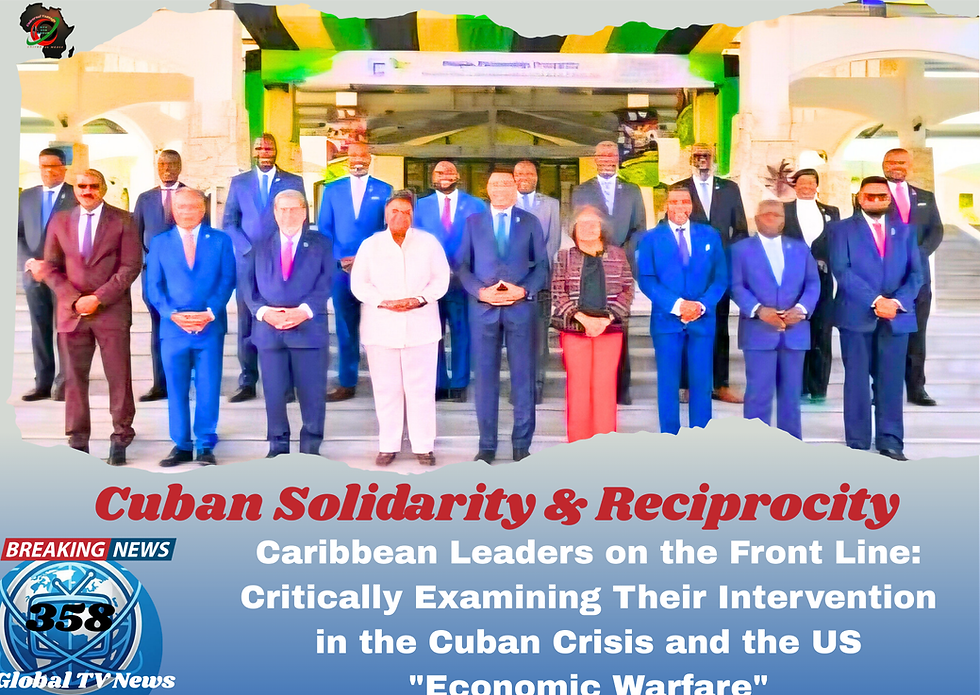
The recent impassioned statement from former CARICOM heads of state and government, unequivocally condemning US actions against Cuba as "economic warfare," marks a significant intervention in the ongoing humanitarian crisis gripping the island nation. This collective denouncement, born from decades of regional solidarity and shared history, provides a critical lens through which to examine the dynamics of the Cuban crisis and the wider implications of US policy in the Caribbean.
The former leaders' statement is remarkable for its strong language, labeling the US executive order threatening sanctions against nations supplying oil to Cuba as inflicting "unconscionable suffering" and a "horrific fuel blockade." This goes beyond diplomatic niceties, directly accusing the US of "cruel punishment of the 11 million civilians" through the strangulation of Cuba's vital requirements for energy, food, medication, education, and basic livelihood. Such a direct and forceful accusation of "economic warfare" by a united front of regional elders carries significant moral and political weight.
Their intervention is underpinned by several critical arguments:
- Humanitarian Imperative: At its core, the statement is a humanitarian appeal. By focusing on the catastrophic consequences for ordinary Cubans – the lack of energy, food, medicine, and education – the leaders seek to shift the discourse from geopolitical rivalry to the urgent need to alleviate human suffering. This aligns with international principles of human rights and the responsibility to protect vulnerable populations.
- Sovereignty and International Law: The former leaders explicitly recall the pivotal 1972 decision by Barbados, Guyana, Jamaica, and Trinidad and Tobago to establish diplomatic relations with Cuba, asserting their "sovereign right to end the hemispheric economic isolation of a neighboring state." This historical reference grounds their current stance in a long-standing commitment to independent foreign policy within the Caribbean. They further argue that the US executive order "undermine the tenets of international law" and endorse the findings of UN Human Rights Experts that it constitutes a "violation of International Law."
- Cuban Solidarity and Reciprocity: The statement powerfully reminds the international community of Cuba's consistent solidarity with the Caribbean, citing "medical brigades, educational scholarships, sports and disaster relief freely given assistance in times of our greatest need and devoid of any request by them for reciprocal support of any kind." This highlights a reciprocal relationship often overlooked in Western narratives, portraying Cuba not as a pariah state but as a benevolent regional partner.
- The "Zone of Peace" Principle: By declaring, "We stand as the Zone of Peace," the CARICOM leaders invoke a fundamental principle of regional foreign policy that seeks to de-escalate conflicts and promote peaceful resolutions. This position directly challenges the confrontational nature of the US embargo and advocates for dialogue and cooperation over coercive measures.
Critical Discussion Points:
While the former leaders' intervention is largely framed as a moral and humanitarian plea, a critical analysis also reveals:
- The Power Imbalance: The "economic warfare" accusation, while strong, underscores the stark power imbalance between the United States and Cuba, and by extension, the smaller Caribbean nations. Their appeal, therefore, functions not just as a condemnation but also as a call for other international actors to leverage their influence to counter US hegemony.
- The Limits of Diplomatic Pressure: Despite decades of CARICOM's consistent opposition to the embargo, and the overwhelming annual UN General Assembly votes against it, US policy has largely remained steadfast. This raises questions about the ultimate effectiveness of diplomatic pressure alone, even when wielded by a united regional front.
- The Role of Regional Unity: The collective voice of these former leaders demonstrates the enduring strength of CARICOM's solidarity on this issue. This unity is crucial for amplifying their message on the global stage, making it harder for the international community to ignore.
- The Call for Tangible Support: The statement's implicit call for CARICOM leaders to "render tangible material support to our brothers and sisters in Cuba at this time of need" suggests that moral condemnation alone may not be sufficient. This opens the door for a more active and coordinated regional response, potentially including increased trade, humanitarian aid, and diplomatic initiatives.
In conclusion, the intervention by former CARICOM leaders is a powerful and critically important moment in the ongoing Cuban crisis. By framing US actions as "economic warfare" and emphasizing humanitarian suffering, international law, and regional solidarity, they are challenging the dominant narrative and pushing for a re-evaluation of policies that have had devastating consequences for the Cuban people. Their call to rescind the executive order and for the international community to provide humanitarian assistance is not just a plea for Cuba, but a broader assertion of the Caribbean's commitment to justice, sovereignty, and a shared future free from coercive economic measures.
Comments