
Sovereignty at the Crossroads: Jamaica’s State Opening of Parliament Amidst Monarchy Debates
- Global TV Press 358

- Feb 12
- 3 min read

By: Wayne Forbes /GTV Editor
February 12, 2026
Sovereignty at the Crossroads: Jamaica’s State Opening of Parliament Amidst Monarchy Debates
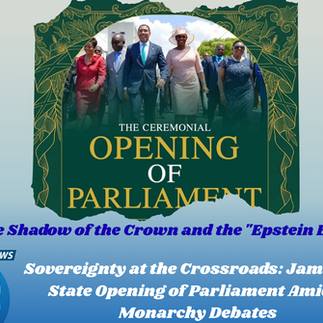
Today, February 12, 2026, the historic George William Gordon House in Kingston hosted the ceremonial State Opening of Parliament. Against a backdrop of military parades and the traditional arrival of the Governor-General, the air was thick with more than just ceremony. As Jamaica prepares for the 2026/27 fiscal year, the nation finds itself at a constitutional precipice: weighing the final severance from the British Monarchy against the complexities of regional judicial independence.
The Shadow of the Crown and the "Epstein Effect"
The push for a Republic has gained unprecedented moral urgency following the latest unsealed documents related to the Jeffrey Epstein files. While the British Royal Family has long faced scrutiny over Prince Andrew’s associations, the continued trickle of revelations has deepened the "republican" sentiment in the streets of Kingston and Montego Bay.
Critically, for many Jamaicans, the monarchy no longer represents a neutral symbol of stability but rather an outdated institution tethered to historical baggage and modern-day scandal. The Epstein files serve as a visceral reminder of the lack of accountability inherent in hereditary systems. If Jamaica is to truly claim its place as a fully sovereign nation, the argument goes, it cannot remain symbolically linked to a foreign house that is currently navigating its own moral and legal crises.
The CCJ Stalemate: A Unified Leap or a Phased Exit?
The most contentious issue of today’s opening, however, isn't whether to become a republic, but how. Prime Minister Andrew Holness and the Jamaica Labour Party (JLP) have favored a "phased approach," moving to a republic first and addressing the final court of appeal later. Conversely, Opposition Leader Mark Golding and the People’s National Party (PNP) have drawn a hard line: they will only support the transition if it includes a "clean break"—simultaneously adopting the Caribbean Court of Justice (CCJ) to replace the UK-based Privy Council.
The government’s current stance remains resistant. The JLP argues that the people should decide on the apex court separately, or perhaps even establish a local final court rather than the regional CCJ. However, this position is increasingly seen as a "half-way house" sovereignty. To remove the King as Head of State while keeping "the King’s judges" in London as the final arbiters of Jamaican law is, in the eyes of many critics, a constitutional contradiction.
The Political Outlook
As the Governor-General delivered the Throne Speech today, the silence on a compromise regarding the CCJ was telling. For the government to accept the opposition's line of "Republic and CCJ together" would require a significant political climb-down for the Holness administration. Yet, without PNP support, the government cannot reach the two-thirds parliamentary majority required to skip a referendum or pass the necessary constitutional amendments.
The reality is that Jamaica is currently "stuck" in a constitutional limbo. The desire for a republic is high, bolstered by the distaste for recent royal scandals, but the political willpower to unify the judicial and executive breaks is low.
Conclusion
The 2026 State Opening of Parliament should have been a victory lap for Jamaican sovereignty. Instead, it serves as a reminder of the work left to do. If the government continues to resist the integration of the CCJ into the republican transition, they risk stalling the movement entirely. In the shadow of the Epstein revelations and the growing calls for reparations, Jamaica’s "one foot in, one foot out" approach to the monarchy is becoming increasingly untenable. True independence requires the courage to trust our own regional institutions as much as we trust our desire for a local President.
Comments