
The Fracturing of Regional Solidarity: KPB, Andrew Holness, and the Specter of Election Interference
- Global TV Press 358

- Feb 25
- 3 min read


By: Wayne Forbes /GTV Editor
February 25th, 2026
The Fracturing of Regional Solidarity: KPB, Andrew Holness, and the Specter of Election Interference
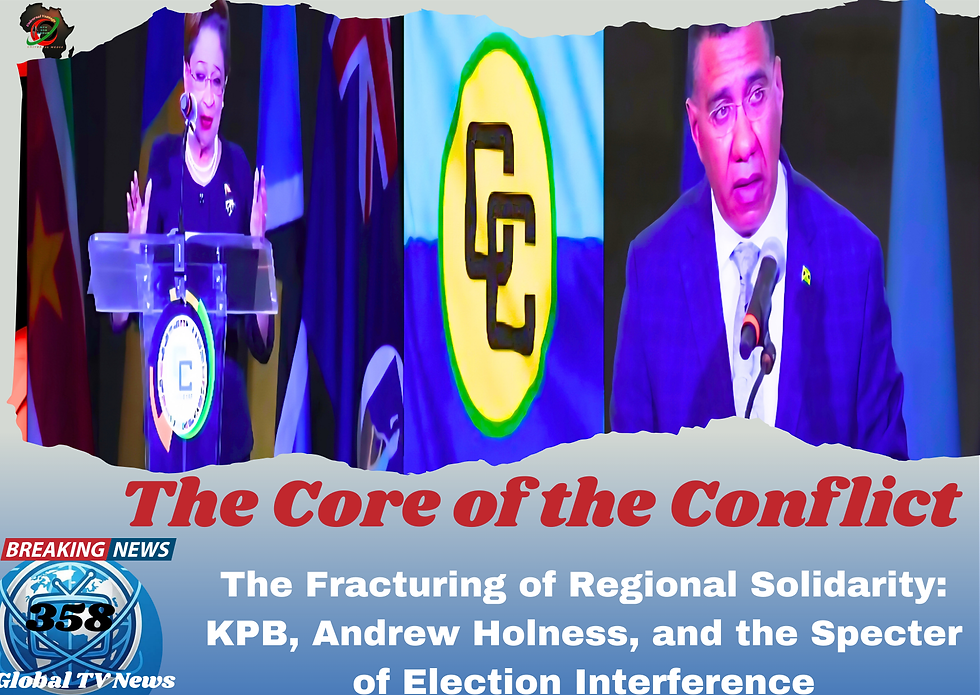
The 50th Regular Meeting of the Conference of Heads of Government of the Caribbean Community (CARICOM) in St. Kitts was expected to be a milestone of unity and cooperation. Instead, it has become the stage for one of the most blunt and public fractures in recent Caribbean history. Prime Minister Kamla Persad-Bissessar (KPB) of Trinidad and Tobago—having recently returned to power in 2025—has set a fire under the "family" table, directly accusing Jamaica’s Prime Minister Andrew Holness of meddling in the domestic elections of CARICOM member states.
The accusation is not merely a diplomatic spat; it is a fundamental challenge to the sovereignty and non-interference principles that have supposedly held the regional bloc together for five decades.
The Core of the Conflict
At the heart of KPB’s critique is a "political invasion" she claims has replaced traditional technocratic cooperation. While she did not initially name Holness in her opening remarks, her subsequent clarification and the surrounding political context made the target undeniable. The grievance stems from allegations that senior political operatives from Jamaica’s Jamaica Labour Party (JLP) were dispatched to provide strategic and ground support to specific incumbent parties in recent regional elections—most notably in the lead-up to Trinidad and Tobago’s own 2025 polls.
"It cannot be that last week you sent your political persons—not technocrats—down to campaign," Persad-Bissessar declared. Her argument is a stark one: CARICOM is being weaponized as a "gentlemen's club" where sitting leaders protect one another’s incumbency by sharing campaign machinery, data, and strategists, thereby tilting the scales against local opposition parties.
A Critical Perspective: Necessary Truth or Destructive Rhetoric?
From a critical standpoint, KPB’s "calling out" of Andrew Holness can be viewed through two distinct lenses.
1. The Defense of Democracy
If the allegations are true, Persad-Bissessar is performing a vital, if uncomfortable, service to the region. CARICOM has long been criticized for being a "talk shop" that turns a blind eye to the internal rot of its members to preserve a veneer of unity. By highlighting "factional divisions," KPB is demanding a reset. If a regional superpower like Jamaica (or Trinidad) uses its resources to influence the democratic outcomes of its neighbors, CARICOM ceases to be a community of nations and becomes a hegemony of incumbents.
2. Strategic Deflection and Domestic Posturing
Conversely, critics of the Prime Minister suggest that her firebrand approach is a calculated distraction. Having labeled CARICOM "dysfunctional" and "rotten" in the months leading up to the summit, KPB may be seeking to externalize domestic challenges. By painting Andrew Holness as a "meddler," she positions herself as a defender of national sovereignty against "outside forces," a classic populist tactic. Furthermore, her support for U.S. interests—even when they clash with CARICOM’s collective stance—suggests that her critique of Holness is less about "regionalism" and more about shifting the bloc’s geopolitical alignment toward Washington.
The Risk to the Bloc
The fallout from this confrontation is severe. The silence from other Caribbean leaders at the summit speaks volumes; many are wary of a public brawl between the region’s two largest economies. Andrew Holness, known for his polished "statesman" persona, now faces the difficult task of defending his party’s regional outreach without appearing to violate the spirit of the Treaty of Chaguaramas.
If CARICOM cannot resolve the tension between KPB’s "Trinidad First" realism and Holness’s expansionist political networking, the 50th-anniversary milestone may be remembered not for integration, but for the moment the "community" began to unravel.
Conclusion
The St. Kitts summit has exposed a "rot" that diplomacy can no longer hide. Whether Persad-Bissessar is the physician diagnosing the illness or the catalyst for the community's implosion remains to be seen. What is certain, however, is that the era of polite, back-room CARICOM consensus is over. The "Holness-KPB" rift is now the defining barometer of whether the Caribbean can truly act as one, or if it will fracture into competing political camps.
Comments